0 readers
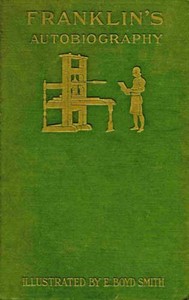
Autobiography of Benjamin Franklin
by Benjamin Franklin
Category: Biography
Status: Available
Source: Public Domain — Project Gutenberg
About This Book
"Autobiography of Benjamin Franklin" by Benjamin Franklin is an unfinished memoir written between 1771 and 1790. Franklin recounts his journey from a young apprentice fleeing Boston to becoming a successful printer and civic leader in Philadelphia. The work famously details his "Project of arriving at moral Perfection" through thirteen virtues, revealing his struggles and philosophies. Written across four parts over nearly two decades, this influential autobiography ends when Franklin was 52, leaving three decades of his remarkable life unrecorded. (This is an automatically generated summary.)
Preview
... (scroll to read more)
About This Edition
This edition of Autobiography of Benjamin Franklin by Benjamin Franklin is catalogued on Libreya under Biography and runs approximately 75,625 words — about 378 minutes of reading at an average pace. It is sourced from Project Gutenberg, the world's oldest digital library of public domain literature, founded in 1971 by Michael Hart, and every text on Libreya has been verified to be free of copyright restrictions in the United States. You can view the original Project Gutenberg edition here.
On Libreya, the text has been carefully formatted for comfortable reading on any screen — with consistent chapter navigation, adjustable font sizes, and four reading themes: light, sepia, dark, and night mode. Your reading position is saved automatically when you sign in, so you can pick up exactly where you left off across any device. The original text has not been altered in any way; what you read here is the same work as it appeared in its original published form.
About Classic Biography
Biography is one of the oldest and most direct forms of literature — the attempt to render a human life with honesty, precision, and narrative shape. The great biographies and autobiographies of the literary tradition offer something that no other form can: direct access to the interior experience of people who shaped history, science, art, and thought. Autobiographical works like Benjamin Franklin's Autobiography, the Confessions of Jean-Jacques Rousseau, or Frederick Douglass's Narrative of the Life offer not just facts but the texture of a lived experience — how the world looked from inside a particular consciousness at a particular moment in history. Classic biographical writing also includes portraits of great figures by those who knew them well, and these accounts carry an immediacy and particularity that later histories often lack. Reading biography is to practice a form of empathy at scale: to inhabit, however temporarily, a life very different from one's own, and to understand from the inside what it meant to live, think, and act in another time and place.